Work from my degree

Technical & Laboratory Work

These are some of the areas where I have developed my technical skills during my Aerospace & Astronautical Engineering degree. I have included the parts I found most useful: what I was trying to understand, how I approached it, and what the results taught me.

Back to Home

Engineering approach

DefineDesignAnalyseTestValidateIterate

Computational analysis

My work

Computational Aerodynamics & CFD

78% · ANSYS Fluent

I modelled finite-wing and boundary-layer flows, using mesh-sensitivity studies and analytical comparisons to understand how modelling choices affect aerodynamic predictions.

78%

Coursework mark

~3.6M

Maximum mesh elements investigated

Technical detail+
  • I investigated meshes up to approximately 3.6 million elements, including adaptive Hessian refinement, while assessing convergence, mesh dependence and computational cost.
  • I compared aerodynamic coefficients and angle-of-attack behaviour with analytical and theoretical models, including laminar and turbulent boundary-layer and transition behaviour.
  • I compared Spalart–Allmaras and k–ω turbulence models to see how turbulence modelling changed the result and the computational trade-off.

What I took from it:The work developed my ability to treat CFD as an analysis and validation process rather than a single plotted result.
ANSYS FluentCFDMesh convergenceBoundary layersTurbulence modellingModel validation

Structural analysis

My work

Finite Element Analysis & Structural Optimisation

72% · ANSYS APDL

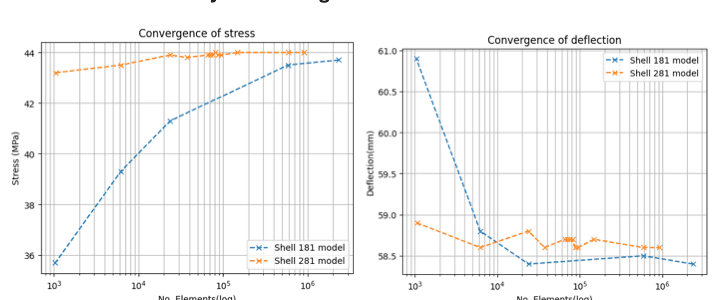
I progressed from 1D beam models through 2D stress-concentration studies to 3D wing-shell analysis, using convergence and design trade-offs to interpret stress, displacement and structural mass.

1D → 3D

Increasing model complexity

72%

Coursework mark

Technical detail+
  • I studied cantilever beams, plates with stress concentrations and full wing-shell models using 1D, 2D and 3D finite elements.
  • I compared linear and quadratic element formulations and conducted mesh-convergence studies to understand the influence of model resolution and idealisation.
  • I evaluated wing thickness and material selection against weight, deflection and factor-of-safety constraints. Here, structural optimisation means an engineering trade-off investigation rather than an automated optimisation algorithm.

What I took from it:The progression in model complexity helped me connect idealisation, numerical convergence and practical structural decisions.

ANSYS APDLFEAStress analysisMesh convergenceStructural analysisDesign trade-offs

Programming & controls

My work

Aircraft Dynamics & Control

Python · NumPy · SciPy · Matplotlib

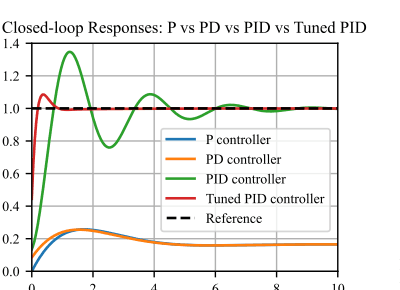
I modelled Boeing 747 longitudinal dynamics and compared a full linearised 3-DoF model with a reduced Short-Period Oscillation approximation before designing and tuning P, PD and PID controllers.

~1%

Short-period model agreement

35% → 9%

PID overshoot

Technical detail+
  • I used state-space, transfer-function and zero-pole-gain representations alongside eigenvalue, time-domain, frequency-domain, Bode and root-locus analysis.
  • The reduced model agreed with the full model to approximately 0.96% in natural frequency (0.9171 versus 0.9260 rad/s) and 1.09% in damping ratio (0.5182 versus 0.5239) for the short-period dynamics.
  • The SPO approximation could not reproduce the low-frequency phugoid mode. I also investigated sensor lag, Gaussian measurement noise, low-pass filtering, sampling and ADC quantisation rather than treating the controller as an ideal system.
  • PID tuning reduced overshoot from approximately 35% to 9%. Stability remained for the tested short-period natural-frequency cases, without implying complete controller robustness.

What I took from it:The useful result was not just a close numerical match: it showed where a reduced aircraft model was useful and where its limitations mattered.

PythonState-spaceFlight dynamicsPID controlSignal effects

Experiment & validation

My work

Experimental Aerodynamics & Model Validation

Wind tunnels · XFOIL · XFLR5 · Python

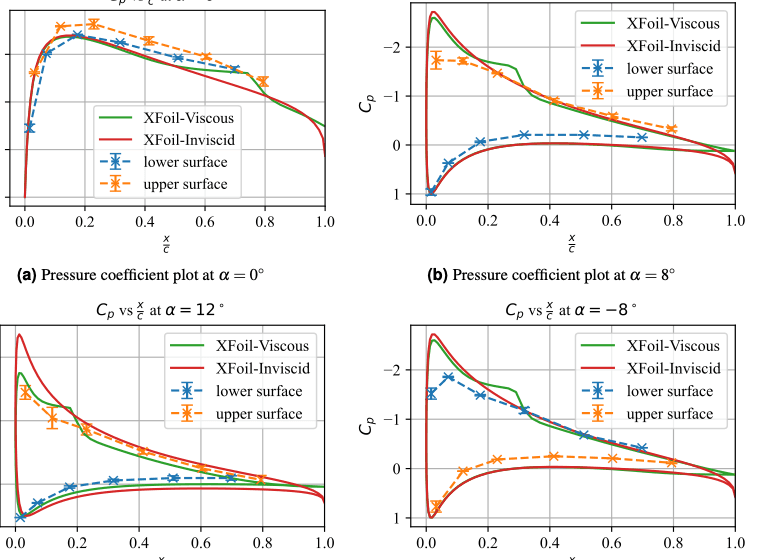
I conducted aerofoil and finite-wing wind-tunnel experiments on a NACA0020 profile, then processed the measurements in Python and compared them with low-order aerodynamic models.

~17%

Lift-curve slope difference

~54%

Glide-ratio prediction difference

Technical detail+
  • I measured velocity, pressure, lift and drag across multiple Reynolds numbers and angles of attack, including boundary-layer and pressure-tapped aerofoil work.
  • I used numerical integration of pressure distributions to obtain lift coefficients and compared the experimental results with XFOIL, XFLR5 and theoretical models.
  • The comparison identified approximately 17% difference in lift-curve slope and 54% difference in glide-ratio prediction. These differences helped identify where simplified drag modelling became less reliable.

What I took from it:This work demonstrates the full evidence loop: experiment, data processing, numerical comparison and critical evaluation of model limitations.

Wind-tunnel testingNACA0020Python data analysisXFOILXFLR5Model validation

I have kept this page to short summaries and selected evidence. My original university reports and source documentation are not published here.